Conny and I just returned from a vacation in southern Africa (including but not limited to capital-S South Africa). Here are a few stories I picked up between the safaris and got curious about.
Five-item Check Lists
Travel guides are clear: the safari tourist’s primary objective is to observe these five animals in the wild: lion, leopard, rhinoceros, elephant, and African buffalo. “Have you already seen the Big Five?” is a common question around the shared dinner tables of safari camps.
In the context of tourism, the Big Five list doesn’t make much sense: These animals are neither the biggest nor the rarest nor the most photogenic (imho). The origin story of the list is hunting: These animals were once considered the most challenging and dangerous ones to hunt on foot.
The tourism industry’s marketing departments have come up with many other lists of five. A sample:
- Ugly Five: wildebeest, hyena, vulture, warthog, and marabou stork.
- Little Five: elephant shrew, antlion, rhinoceros beetle, buffalo weaver, and leopard tortoise.
- Shy Five: aardvark, aardwolf, porcupine, bat-eared fox, and meerkat.
Elsewhere entirely, the Big Five are Openness, Conscientiousness, Extraversion, Agreeableness, and Neuroticism. Back home in Utah we have the Mighty Five: Zion, Bryce, Capitol Reef, Canyonlands, Arches—the state’s National Parks.
Empty Passport Pages
You know how passports have all these empty pages behind the one page where you can double check what your official eye color is? The ones that remain empty if you only ever travel to places like Schengen, Singapore, Canada? Here is how you fill those pages:
- 8:30am, Impalila Island, Namibia. Add one more stamp to the five others acquired during Namibia immigration three days earlier. Thanks to some minor overlap, three days in Namibia consume only one full passport page.
- 8:50am, Kasane Immigration Office, Botswana. A small rectangular red arrival stamp plus the officer’s signature squiggle. With good aiming you could fit eight of those on a page.
- 9:15am, Kazungula Road, Botswana. One more rectangular red stamp plus squiggle to acknowledge the end of our quick half-hour stay.
- 9:30am, Kazungula Border Post, Zimbabwe. Don’t let Google Maps fool you: there is no buffet restaurant here. Zimbabwe’s entry stamp is slightly larger than Botswana’s, thanks to the elaborate double-framed design. 1/6th of a page. This is our second entry on a double-entry visa, therefore no quarter-page sticker with QR code this time.
- 10:50am, Victoria Falls Airport, Zimbabwe. “Zim” pairs their rectangular immigration stamp with an oval one for emigration.
- 2:10pm, Airfield of Kruger Mpumalanga Airport, South Africa. The international arrivals door locked. We stand on the airfield and ring the door bell.
- 2:20pm, Arrivals Hall of Kruger Mpumalanga Airport, South Africa. The SA immigration officer, now with shoes on and a stamp set to today’s date, adds a quarter-page octagonal ASCII art style stamp.
Namibia’s Panhandle
Impalila Island is located at the very end of Namibia’s panhandle. On the big map of Africa this looks like a four corners point of (counter-clockwise) Namibia, Botswana, Zimbabwe, and Zambia. What’s actually happening is that Botswana and Zambia share a 150-meter border, crossed by the Kazungula bridge, while Namibia and Zimbabwe never come closer than those 150 meters.
The Namibia “panhandle” is the Caprivi Strip, named after a German chancellor who succeeded the better-known Bismarck in 1890. Mr. Caprivi negotiated the Heligoland–Zanzibar Treaty in which Germany acquired the Caprivi Strip for its colony, thinking that access to the Zambezi River would result in a shipping route to the Indian Ocean. One small problem: Victoria Falls.
Elephant Fences
During our stay in Namibia we joined a tourist tour of a village in the Caprivi Strip. One subtext throughout the tour: Conservation efforts by the government interfere with life as previous generations in the village lived it.
Hunting and fishing are restricted, and growing elephant populations make farming in the open country a pointless endeavor. The government compensates through payments and provides infrastructure such as solar panels and water pipes. No doubt that my summary glosses over much complexity and conflict.
The tour guide, while standing in front of a Damara milk-bush: “Recently a government official told us about elephant fences made with chili peppers from the market and the fruits of this tree. Apparently, elephants stay away from any field surrounded by such a fence. We are now waiting for another visit from the government to learn more about this!”
I’ve watched Youtube videos about these fences and read about them long before this vacation. Despite having no use for an elephant fence. Meanwhile, the folks in Namibia who stand to benefit most are waiting a few months to learn more from a government official.
Wasn’t this the original big promise of the information superhighway? That people everywhere can share knowledge to better their lives?
That was a rhetorical question of course. I doubt access is the issue because I saw smartphone users in the village. But it’s not like the apps on my smartphone are designed to surface information to improve my life either.
Hiking
At home, I’m out hiking in the mountains at least once a week. In countries where lions and elephants roam, leisurely walks through the countryside are understandably not a common activity.
The taxi driver explained the sights during the 30-minute drive from Victoria Falls Airport to downtown. “On the right is our hiking spot.” Lots of people around and cars parked, a trailhead.
“Really? Where do people go to?” — “All the way to our capital city, Harare. It takes several days.”
…
Hiking means something else around here! These hikers might even have to stop at a few robots!
Roadside
You drive a truck of valuable Zimbabwe exports towards the Botswana border. You just passed the road construction crew with its four laborers plus one guy who carries a rifle and stares at the bush. Suddenly smoke comes out of your engine and you lose power. Despite your best efforts the engine remains dead. What do you do?
Hike to the next town, of course. Find help. Get spare parts. Then hike back to your truck and fix it right there, on the road through the national park, with giraffes crossing.
When we first drove past the broken-down truck, they had just dropped the engine and were working on it. One week later on our return trip, the engine was back in. Our driver told us that the truck had been in this spot for four weeks already.
I wonder what the tracking website for the cargo says.
Airport Antiquities
Did you know that many of the luxury boutiques at airport terminals aren’t owned by the brand whose name is on the store but by companies like Avolta that broadly specialize in airport stores?
Definitely not operated by a corporate overlord: the antiques and books store in the Victoria Falls Airport. On sale: second-hand books, artworks, flea market wares, and historical stamps (but not current ones). The highlight presented right at the door: a coffee-table book signed by Robert Mugabe.
Billionaires
Locals in Victoria Falls (the town) are quick to assure you that it’s safe to walk around during daytime. Allegedly, there is no crime or pickpocketing. (Stay inside after dark, though: the hippos grazing on the town square can be dangerous.)
Street vendors are everywhere, and proactive. One commonly offered product: billions and trillions of Zimbabwe dollars.
“Those were crazy times, overnight we all became billionaires! My family still has a suitcase full of billion-dollar banknotes at home!” said one hotel staff member.
I wouldn’t wish hyperinflation on anyone, but now that the banknotes exist we might as well use them. In the US you can order stacks of Zimbabwe dollar notes up to 100 trillion on various web stores. I’ve previously used these as prize money in “Who Wants to be a …llionaire” quizzes in presentations and trainings at work.
Paper Money
A few steps down the terminal from the antiques store I tried to buy a fridge magnet for the collector in the family. How do you pay in a country that has abandoned its own currency? The US Dollar is the universally accepted option (together with South African Rand).
“No. Do you have a newer one?” said the fridge magnet vendor after I handed her a used but imho definitely not fake Andrew Jackson.
I had walked straight into the practical issues with using the US Dollar as currency when you’re not able to print replacement physical money. How do the old torn notes ever get replaced with new ones? NPR’s Planet Money archives contain not one, not two, but three classics on the topic. This airport vendor’s solution was simply to demand fresh paper money from the tourists.
Starlink
Talking about billionaires: Starlink does not operate in South Africa. The satellite signals reach the country, of course, but SpaceX doesn’t have a license to operate a telecom service there.
The workaround, as explained by one of our hosts: Purchase two mobile Starlink receivers. Operate one inside South Africa and one outside. Just before you hit the six-month mark: Swap the receivers. Ensure that no receiver operates inside the country for more than six months per year.
How to Overtake
Picture a two-lane road between two cities. How do you (legally) overtake?
The slower car ahead of you moves over to the shoulder and continues at its regular speed. If it doesn’t you might give them a friendly reminder.
You pass. If necessary, you move a little bit into the oncoming lane. They will probably make space for you. Unless there’s someone overtaking there too.
Switch on your hazard flashers for a few seconds. “Thank you!”
Check the rearview mirror to see the headlight flashing from the passed car. “You’re welcome.”
The key to this process is driving on the shoulder. This is indeed legal in South Africa, but only in daylight, when the shoulder is clearly visible and unobstructed.
Copper Trucking
One vehicle frequently driving on the shoulder of highway R40: a side-tipping truck-trailer.
Palabora Copper mine is located at the northern end of R40 in Phalaborwa. Southbound, these trucks carry copper and copper-mining by-products like magnetite from the mine to the nearest deep-water port in Maputo, the capital of neighboring Mozambique. Northbound, they come back empty.
A railway line connects the Palabora mine to Maputo, Durban, and Richards Bay. Most of the mine’s output traveled on this line until circa 2010. The complex sequence of events that led to up to 650 trucks per day carrying much of this cargo instead gets summarized as “Transnet collapse.” Transnet being South Africa’s state-owned freight transport and logistics company.
Debates about whether potholes are caused by too many trucks or too little maintenance spending seem to be a hot topic along the R40 corridor.
I’ve struggled to get real stats on this train line. It seems like trains never fully stopped and train volume has been increasing in recent years. As of 2025, one weekly train slot was up for grabs for private rail operators. Probably next up: trucking companies lamenting that the same government that created their business is now destroying it.
Guide School
Safari guiding isn’t an easy job. You drive an oversize vehicle on gravel roads or worse, keep up to eight tourists entertained in English even when that’s neither your nor their native language, spot well-camouflaged wildlife before the tourists do, operate a radio, operate a spotlight when it’s dark, read animal tracks, serve morning snacks and sundowners, retain encyclopedic knowledge about local flora, fauna, geography, culture, star constellations, etc.
The general pattern: a legally mandated certification, earned by attending guide school. Six months of classroom training plus six months of internship seem to be the standard across the locations we visited.
In South Africa there seems to be a bit of animosity between two professional associations that offer field guide training courses and certifications: FGASA (Field Guides Association of Southern Africa) and IFGA (International Field Guide Association). I’m definitely staying out of this one, but it sounds like guiding trainees are in a bit of a pickle because they have to pick which one to pursue and employers require one or the other, resulting in a bifurcated employment market.
More Fences
Geoguessr advice: If there are walls and fences everywhere, you might be in South Africa. If the fences have large prominent signs with security company names attached, it’s all but sure.
South Africa has a high rate of crime. In the city, residential properties are surrounded by walls which are often topped with electric fencing. In the countryside, farms have fences and security cameras all around their perimeter including the fields and orchards. Back home the city zoning rules ban fences higher than four feet in our neighborhood, for sightlines.
A second reason for South African fencing is that wildlife areas have hard boundaries formed by fences. These areas can be large reserve complexes like the famous Greater Kruger Park with its many public and private constituents. Contrast that with neighboring Botswana and Zimbabwe where the park boundaries are much more porous to wild animals.
Stoffel Update
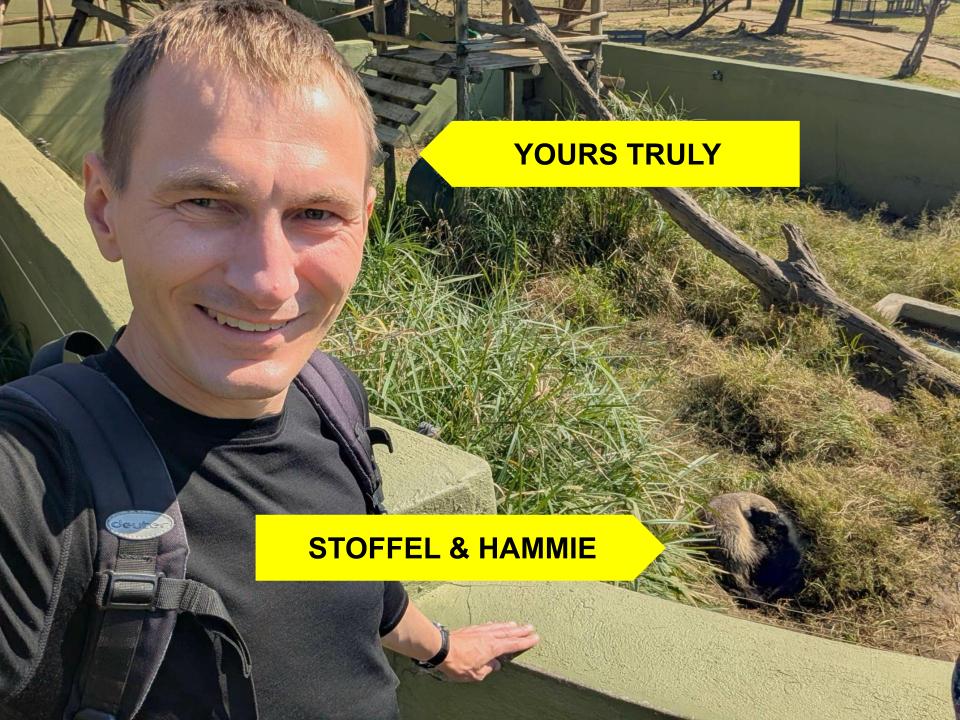
Stoffel, the Houdini of honey badgers, who does not care at all about fences and fearlessly escapes his enclosure to fight the lions, became famous in this clip from the 2014 BBC documentary “Honey Badgers: Masters of Mayhem.”
Here’s the 2026 update on Stoffel:
Stoffel is 28 years old and still resides in the same high-walled enclosure at Moholoholo wildlife rehabilitation center near Hoedspruit. He is one of the permanent residents there, the animals who cannot be rewilded, that you can visit on a public tour. On the day of my visit he was chilling with his partner Hammie. No recent escape stunts, they are retired. We didn’t meet their son, Stompie.